
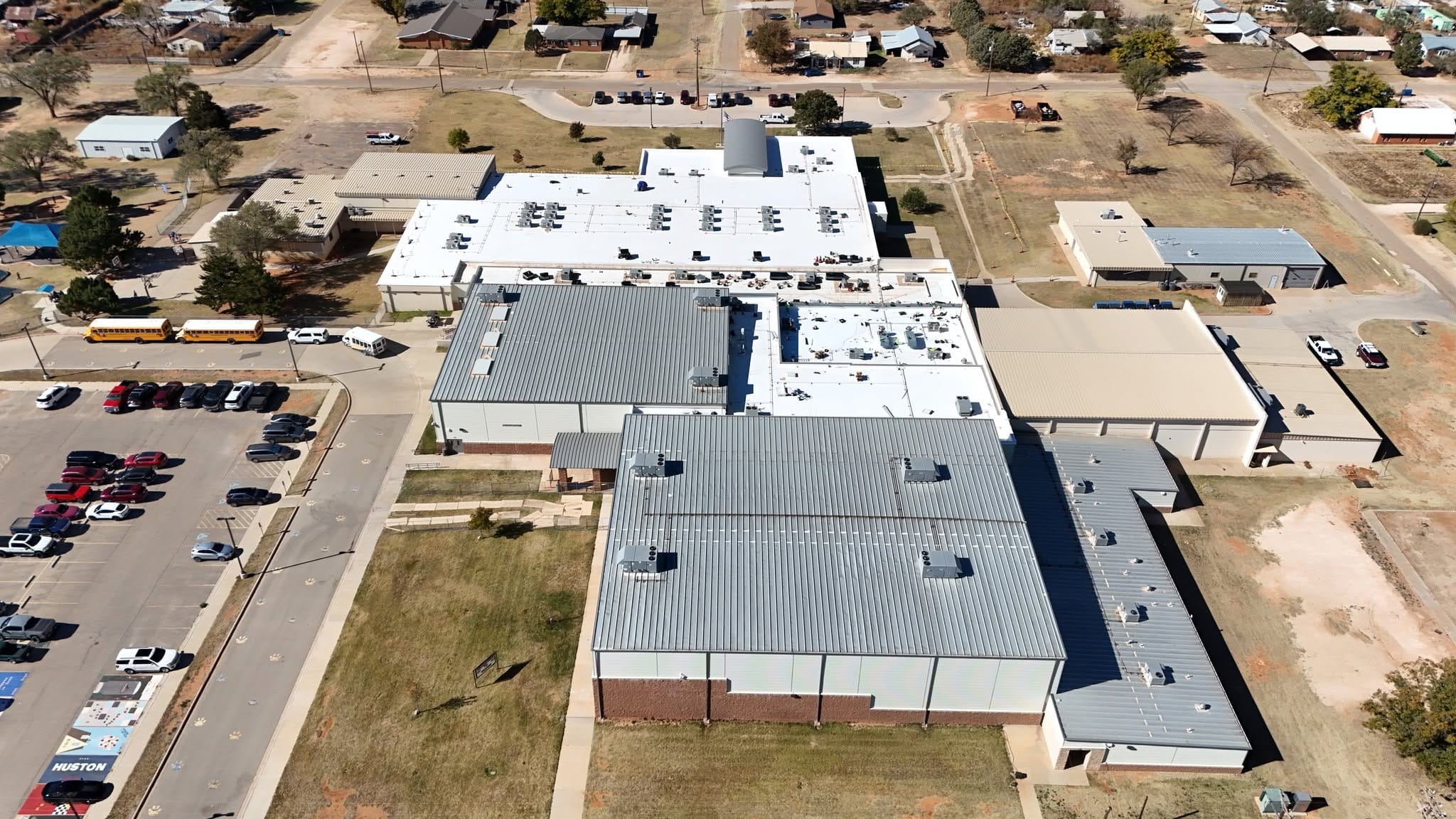
A Guide for Facility Managers, Architects, School Districts and Industrial Property Owners
Choosing the right commercial roofing system in West Texas requires more than comparing installation costs. Extreme summer temperatures, prolonged ultraviolet (UV) exposure, strong winds, severe thunderstorms and damaging hail all influence how a roofing system performs over time.
For large commercial and industrial facilities, roofing decisions can affect building operations, energy consumption, maintenance expenses and long-term capital planning.
At Roofs Inc., we specialize in large-scale commercial and industrial roofing projects throughout West Texas, the Texas Panhandle and Eastern New Mexico. Our experience includes educational facilities, manufacturing plants, warehouses, healthcare facilities and other complex commercial properties.
Understanding the strengths and limitations of different roofing systems is an important first step toward selecting the right solution.
TPO Roofing: A Popular Choice for Large Commercial Buildings
Thermoplastic polyolefin (TPO) is widely used on low-slope commercial and industrial roofs. TPO membranes are commonly available in white and other colors, with white membranes offering high solar reflectance that can help reduce rooftop heat absorption.
Advantages of TPO Roofing
- Energy performance: Reflective white membranes can reduce solar heat gain and may lower cooling demand depending on building conditions.
- Heat-welded seams: Properly installed seams create durable, watertight connections.
- Large-scale applications: TPO systems are well suited to warehouses, educational facilities, retail buildings and industrial structures.
- Installation flexibility: TPO can be installed using mechanically attached, adhered or other manufacturer-approved systems.
- Maintenance: Accessible membrane surfaces can simplify routine inspections and certain repairs.
Considerations for West Texas
Hail resistance, wind uplift performance, insulation design, membrane thickness and the condition of the underlying roof assembly all deserve careful evaluation.
A thicker membrane alone does not guarantee superior hail performance. Cover boards, attachment methods, insulation and tested assembly performance can significantly affect durability.
Best applications: Large warehouses, schools, commercial offices, manufacturing facilities and other low-slope buildings.
PVC Roofing: Performance for Specialized Industrial Environments
Polyvinyl chloride (PVC) roofing is another thermoplastic membrane system commonly used on commercial and industrial buildings.
Like TPO, PVC membranes feature heat-welded seams and are available in reflective colors.
One of PVC’s distinguishing characteristics is its suitability for certain environments involving grease, oils or chemical exposure, subject to manufacturer-specific compatibility requirements.
Advantages of PVC Roofing
- Heat-welded seams
- Reflective membrane options
- Suitability for certain chemical and grease exposures
- Options for complex commercial roof configurations
- Established use in commercial and industrial applications
Important Considerations
PVC systems may have higher initial material costs than some TPO alternatives. Compatibility with specific chemicals, rooftop equipment and environmental conditions should always be verified.
Best applications: Certain manufacturing facilities, commercial kitchens, food-processing facilities and specialized industrial buildings.
Commercial Metal Roofing: Long-Term Durability and Architectural Flexibility
Metal roofing is frequently selected for industrial facilities, warehouses, agricultural buildings, institutional properties and commercial structures.
Depending on the building design, metal roofing systems may include standing-seam panels, exposed-fastener systems or other engineered assemblies.
Advantages of Commercial Metal Roofing
- Long potential service life with proper design and maintenance
- Strong wind-uplift performance when appropriately engineered and installed
- Variety of panel profiles, coatings and finishes
- Compatibility with custom flashing and architectural details
- Opportunities for retrofit and new-construction applications
The Importance of Proper Fabrication
Commercial metal roofing performance depends heavily on details such as flashing, penetrations, transitions, edge conditions and drainage.
Roofs Inc. operates an in-house metal fabrication division, allowing our team to produce custom metal components for commercial roofing projects.
These capabilities include:
- Metal coping and edge components
- Gutters and downspouts
- Custom flashing and trim
- Wall panels
- Roof transitions and specialty metal details
Having Fabrication capabilities within the company helps coordinate roofing installation with project-specific metal requirements.
Best applications: Industrial buildings, warehouses, institutional facilities, commercial structures and projects requiring extensive custom metal detailing.
Roof Coatings: An Option for Suitable Existing Roofs
Commercial roof coatings can sometimes extend the useful life of an existing roofing system without requiring a complete replacement.
However, coatings are not a substitute for correcting saturated insulation, deteriorated decking, significant structural problems or other underlying deficiencies.
Before recommending a coating system, a qualified contractor should evaluate:
- Existing membrane condition
- Moisture intrusion
- Drainage and ponding conditions
- Adhesion and material compatibility
- Manufacturer requirements
- Remaining service life
For large industrial facilities, determining whether restoration or replacement offers the better long-term value requires a careful evaluation of the existing roof.
Comparing Commercial Roofing Systems
| Roofing system | Common applications | Primary considerations |
| TPO | Warehouses, schools, commercial buildings | Reflectivity, assembly design, wind and hail resistance |
| PVC | Specialized industrial and food-processing facilities | Chemical compatibility, cost, assembly performance |
| Metal | Industrial, institutional and commercial buildings | Panel design, expansion, attachment, detailing |
| Modified bitumen | Low-slope commercial buildings | Installation method, surfacing, maintenance |
| Roof coatings | Suitable existing commercial roofs | Substrate condition, moisture, compatibility |
No single roofing system is ideal for every building. The best choice depends on the structure, environmental exposure, operational requirements and long-term ownership objectives.
Why West Texas Weather Demands Special Attention
Commercial roofs in West Texas face a demanding combination of environmental conditions.
Severe Hail
Hail can damage membranes, insulation, metal panels, rooftop equipment and flashing.
Roof assemblies should be evaluated for appropriate impact-resistance performance, including relevant testing and insurance requirements.
High Winds
Wind uplift is especially important on large commercial buildings with substantial roof areas.
Proper attachment, perimeter and corner-zone design, edge securement and tested system assemblies are critical.
Extreme Heat and UV Exposure
Prolonged sun exposure can influence membrane aging, surface temperatures and energy performance.
Reflective roofing systems can offer advantages in certain applications, but overall performance depends on the complete roof assembly.
Large Temperature Changes
Thermal movement affects roofing materials, metal components and roof transitions.
Proper detailing and allowance for expansion and contraction help maintain long-term performance.
What Should School Districts and Industrial Facility Managers Look for in a Roofing Contractor?
Large commercial roofing projects require more than installation experience.
Before selecting a contractor, building owners and project teams should consider:
- Comparable project experience: Has the contractor successfully completed projects of similar size, complexity and occupancy?
- Workforce and supervision: Does the contractor have the personnel and management capabilities to support demanding schedules?
- Safety practices: Are employees properly trained for the work and conditions involved?
- Manufacturer requirements: Can the contractor install the specified system and coordinate required inspections and warranty documentation?
- Custom fabrication capabilities: Can specialized metal details and transitions be produced and coordinated efficiently?
- Project coordination: Can roofing operations be integrated with other trades and ongoing building activities?
These considerations are particularly important for occupied schools, healthcare facilities, manufacturing plants and industrial properties where construction activities must be carefully coordinated.
Large-Scale Commercial & Industrial Roofing by Roofs Inc.
Roofs Inc. is a commercial and industrial roofing contractor based in Lubbock, Texas, serving West Texas, the Texas Panhandle and Eastern New Mexico.
Our experience includes major roofing projects involving school districts, industrial facilities, commercial buildings and institutional properties.
Our capabilities include:
- Large-scale TPO and low-slope roofing installations
- Commercial and industrial roof replacement
- Commercial metal roofing
- In-house sheet metal fabrication
- Custom flashing, coping, gutters and downspouts
- Commercial roof maintenance and repair
Our project experience includes major industrial work such as the Leprino Foods facility in Lubbock, as well as educational and institutional roofing projects throughout the region.
Planning a Commercial or Industrial Roofing Project?
Whether you’re planning a major roof replacement, designing a new industrial facility or evaluating roofing systems for an educational campus, selecting the appropriate roof assembly and an experienced contractor is essential.
Contact Roofs Inc. to discuss your commercial or industrial roofing requirements.
Roofs Inc.
Lubbock, Texas
Phone: 806-771-9780
Website: www.roofsinctx.com
Serving West Texas, the Texas Panhandle and Eastern New Mexico.