
Restore an aging commercial roof. Reset the warranty clock. Skip the tear-off.
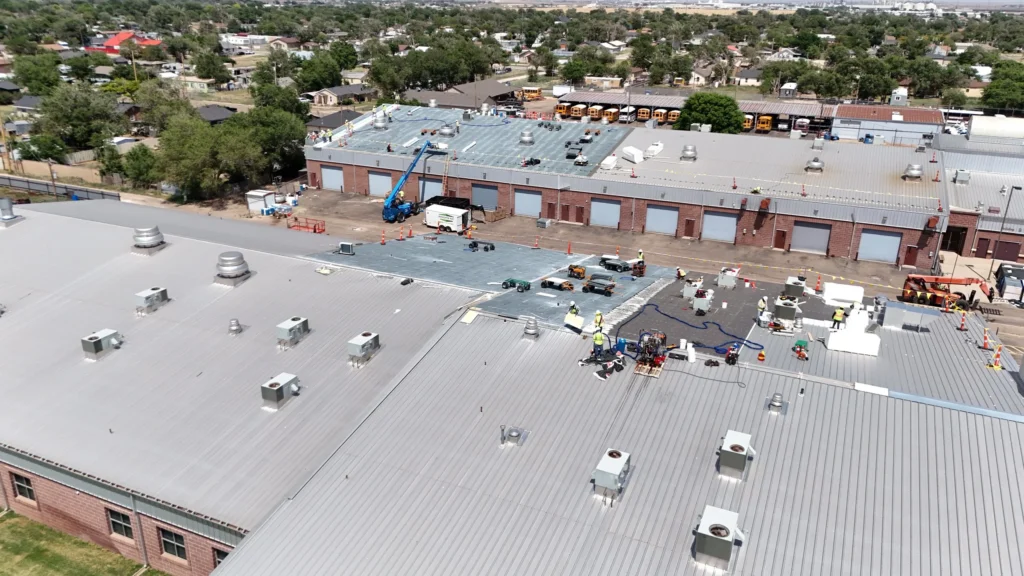
Typical renewed service life
Solar reflectance on white silicone
No seams, no fasteners, no laps
Spray-applied by Roofs Inc crews
The right call when the roof is tired, not failed.
Most commercial roofs in West Texas and New Mexico fail from the top down, not the bottom up. The membrane is intact. The deck is dry. The insulation is holding its R-value. What’s gone is the surface — chalked, UV-cooked, hairline-cracked, no longer shedding water the way it used to. A tear-off at that point rebuilds a roof that didn’t need rebuilding. A properly specified coating restores the surface, reseals the laps and penetrations, and gives the owner another 10 to 15 years on the system that’s already there.
That is the specific window a roof coating fills. The right coating over a sound TPO, PVC, modified bitumen, metal, or BUR roof turns an impending capital project into a maintenance line item — and in the process delivers a white reflective surface that cuts rooftop temperatures 50 to 70 degrees on a West Texas August afternoon. That reduces cooling load, pulls down utility bills, and buys the HVAC equipment a few more years of service life too.
Roofs Inc installs manufacturer-warranted silicone, acrylic, and polyurethane coating systems across the Permian Basin, the South Plains, and SE New Mexico. We are commercial-only, we spray with in-house crews, and we only coat a roof when the roof is actually a coating candidate. A saturated membrane needs replacement, not paint.
Silicone / Acrylic / Urethane
The three chemistries we spec across West Texas and New Mexico.
- Thickness
- 20–30 mils applied
- Attachment
- Spray, roller, or brush
- Surfacing
- White, tan, or gray reflective
- Warranties
- 10–20 yr manufacturer renewable
Coating systems we install
Three chemistries, matched to the substrate and the exposure.
01. Silicone (SPC)
The default for low-slope West Texas and New Mexico roofs. Single-component moisture-cure chemistry that handles ponded water, resists UV degradation, and holds reflectance better than any competing chemistry over a 15-year horizon.
02. Acrylic (water-based)
Lower cost per square, excellent dirt pickup resistance, and the right call on sloped roofs or buildings in moderate-exposure markets. Not for ponded water. Fastest cure in warm weather.
03. Polyurethane (aromatic & aliphatic)
The hardest, most abrasion-resistant coating chemistry we spec. The right call where rooftop foot traffic is heavy — HVAC crews, service techs, ladder bays. Aliphatic urethane holds color and gloss as a top-coat over base layers.
04. Metal roof restoration
Rust encapsulation, fastener seal, seam reinforcement, and a reflective top coat over a weathered standing-seam or R-panel metal roof. Resets the service clock without tearing off the panels.
05. Single-ply restoration
Silicone or acrylic over a sound but weathered TPO or PVC membrane. Reseals seams, laps, and penetrations. Extends service life past the original manufacturer warranty.
06. Mod bit & BUR restoration
Granular embedment and a reflective top coat over an aging modified bitumen or built-up roof. Restores the UV layer that was absorbed into the cap sheet without a full tear-off.
Diagnose first. Spray only what will hold.
Moisture scan & core sample
Infrared imagery and physical cores to confirm the insulation is dry and the deck is sound. A saturated roof fails the coating candidacy test — we recommend replacement instead.
Prep & clean
Power-wash, prime the substrate, reinforce seams and penetrations with polyester mesh, and detail flashings and curbs so the finished coating is monolithic.
Spray application
Two-coat system applied to manufacturer-specified mil thickness, with wet-mil gauges logged on every pass. White reflective top coat on the final layer unless the owner specifies tan or gray.
Warranty & renewal
Manufacturer-issued 10, 15, or 20-year warranty on the finished system. Many silicone warranties are renewable with a re-coat — the roof becomes a maintainable asset instead of a 20-year countdown.
Specify to the substrate condition, not the budget wish.
Coat vs. replace
The five questions that decide which path a roof takes.
- Membrane sound
- Yes = candidate
- Insulation dry
- Yes = candidate
- Seams holding
- Reinforce + coat
- Ponding water
- Silicone only
- Saturated deck
- Replace, not coat
A roof coating is the right call when the substrate is sound and the surface is worn. It is the wrong call when the insulation is wet, when the deck is failing, when the seams are blown, or when the membrane itself is past its structural service life. Coating over a saturated roof traps moisture, accelerates deck decay, and voids the manufacturer warranty. We will not do it, and we are plain about that in the assessment report.
What a coating program delivers to an owner who does qualify: a reset warranty, a reflective white surface that cuts cooling load, a monolithic membrane that reseals aging seams and penetrations, and a predictable maintenance schedule going forward. Pair the coating with roof maintenance and the renewed system holds for 15 years with inspections twice a year. Skip the maintenance program and the clock starts running faster.
For storm events on a coated roof, see storm damage repair; for post-hail documentation and carrier submission, see insurance claims. For buildings where coating isn’t a fit and the roof needs full rebuild, see commercial roof replacement.
Commercial roof coatings, answered.
A properly specified and installed silicone system runs 15 years on West Texas and New Mexico roofs, with the manufacturer warranty renewable at that point by applying a maintenance top coat. Acrylic systems run 10 to 12 years. Polyurethane runs 10 to 15. The variables that move it: substrate prep quality, applied mil thickness, roof slope and ponding, and whether a maintenance program is in place.
Silicone is the right call on any roof that holds standing water, on roofs with high UV exposure, and anywhere the owner wants the longest possible service renewal. Acrylic is the right call on sloped roofs with no ponding, on buildings where budget is tight, and where the owner is comfortable with a shorter warranty horizon. Our assessment identifies which fits your roof. Both can carry 10 to 20-year manufacturer warranties when installed to spec.
No. A coating applied over wet insulation traps the moisture, accelerates deck corrosion, and voids the warranty. The assessment step always includes an infrared moisture scan and physical core samples. If wet insulation is found, we recommend selective tear-out and replacement of the saturated area before coating — or, if the saturation is widespread, full roof replacement. We will not coat a roof that won't hold the coating.
Yes, measurably. A white silicone or acrylic top coat with 80%+ solar reflectance reduces rooftop surface temperatures 50 to 70 degrees on a West Texas August afternoon versus a dark aged membrane. For a typical commercial building that translates to 10 to 20 percent lower cooling load during peak summer months. The reduced thermal cycling also extends the service life of the HVAC equipment on the roof.
No. Spray-applied coatings are a cold process — no open flame, no kettle, no tear-off dust. Occupied retail, schools, hospitals, offices, and oilfield service buildings all continue normal operations while we coat the roof above them. We coordinate access, hatch and curb protection, and spray-day weather windows to keep the building running.
In most cases a properly installed coating is approved by the original membrane manufacturer as a maintenance system and preserves the underlying warranty. For roofs already outside their original warranty, the coating issues a fresh manufacturer warranty on the newly restored system. We handle the manufacturer approval and warranty paperwork as part of the project — you receive the warranty certificate at close-out.
Our crew. Roofs Inc sprays coatings with in-house teams trained on silicone, acrylic, and polyurethane application and certified by the manufacturers we install. Coating quality is set at the gun — mil thickness, substrate prep, seam reinforcement, and weather-window judgment. Those decisions stay with our people.